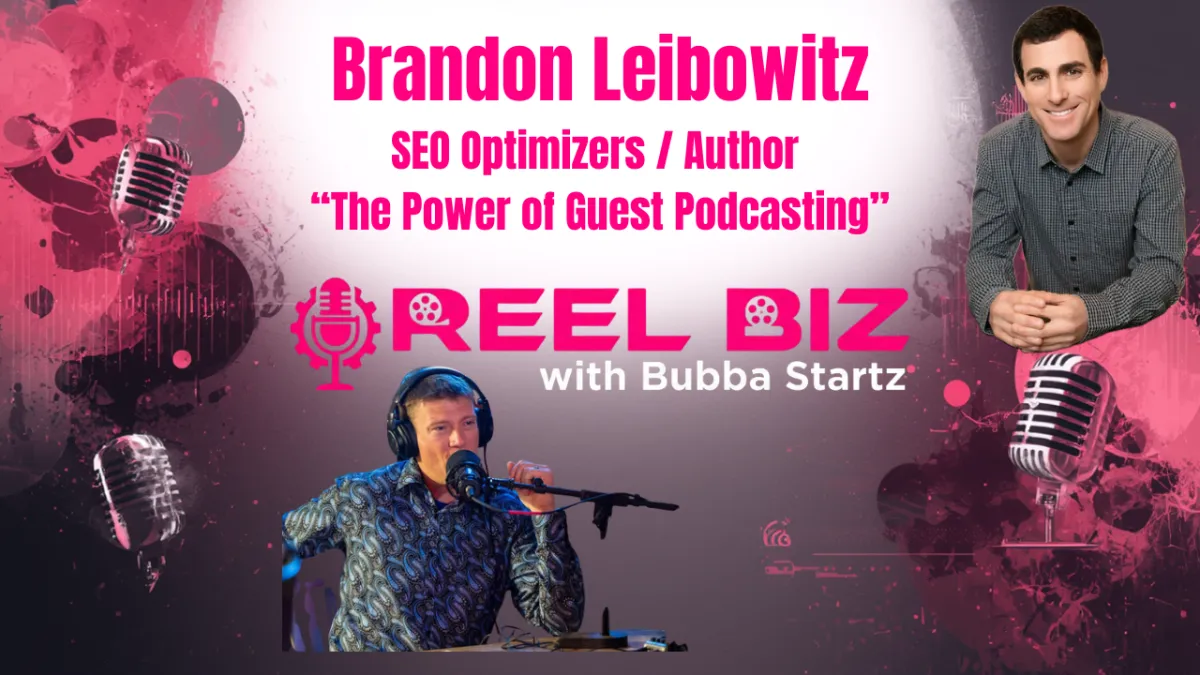
The Power of Guest Podcasting: How Brandon Leibowitz Uses Backlinks & SEO to Grow Traffic
REEL BIZ: How Guest Podcasting + SEO Built a Traffic Engine — Interview with Brandon Leibowitz
If you’re a podcaster, entrepreneur, or small-business owner who’s frustrated that your content isn’t being seen, this episode of REEL BIZ with SEO expert Brandon Leibowitz is a must-listen. Brandon — founder of SEO Optimizers — breaks down why guest podcasting is one of the most powerful, underused SEO strategies available today and how podcast hosts and guests can convert every episode into lasting search visibility and traffic.
Below I’ve distilled the key takeaways from our conversation and added actionable steps you can use right away. If you want to go deeper, check out Brandon’s company at https://seooptimizers.com and his book The Power of Guest Podcasting (available here: https://a.co/d/0bJ0cS00).
Why guest podcasting matters for SEO (and revenue)
Third-party validation builds trust. Search engines and AI language models reward signals that show authority across multiple independent properties. When you appear on other people’s websites and platforms, those mentions act like votes of confidence.
Distribution multiplies exposure. A guest episode is published on the host’s website, shared on social channels, and appears across podcast directories — giving your name and brand presence in many places at once.
Guests get backlinks. When hosts publish episodes on their sites and include show notes with your website URL, you win backlinks — one of the strongest SEO trust signals.
LLMs and AI increase the value of diverse online footprints. Large language models pull answers from many content sources (web pages, social, podcast transcripts). Being present across platforms helps AI systems find and surface you when users ask for expertise.
Common misconceptions Brandon debunks
“SEO is dead because of AI.” Not true. The fundamentals remain the same. AI changes where people search and how queries look (more conversational, longer phrases), but search engines and LLMs still rely on signals — keywords, schema, backlinks, and authority.
“Podcasting is only for awareness.” While it’s great for visibility, guesting can be a direct SEO tactic that drives long-term organic traffic through backlinks and published episode pages.
“Pretty websites are enough.” Visual design helps human visitors, but search engines care about code, metadata, keywords, schema, and conversion paths. Pretty ≠ discoverable.
Practical steps to turn every podcast appearance into SEO value
Insist on a show note page with your URL
Ask the host to publish the episode on their site and include your website URL in the episode description/show notes. If it’s missing, politely request an update. Your site link is SEO gold.
Get your name and website mentioned (not just social handles)
Hosts sometimes link only to social profiles; request they include the canonical website URL (e.g., yourdomain.com) because that’s what passes the most SEO value.
Turn episodes into blog posts
Hosts should publish each episode as a dedicated blog post (transcript, summary, embedded player). This creates an indexed landing page for that episode and multiple ranking opportunities (episode title, guest name, topics discussed).
If you’re the host, prioritize building these pages. If you’re a guest, ask the host for the page URL so you can share it.
Use transcripts and FAQs
Provide or request a transcript. Transcripts add keyword-rich content and help LLMs understand the episode topic. Adding a short FAQ section (with schema markup) can boost how an episode shows up in AI-powered answers or featured snippets.
Optimize for conversational queries
Voice and AI search use longer, question-style queries. Make sure episode pages and show notes include natural-sounding phrases and full-sentence questions you heard in the conversation.
Build backlinks strategically
Beyond podcast pages, publish a short follow-up post on your own site linking to the host’s episode page (and ask them to link back). Cross-promote on social with the host’s site URL — you’ll likely attract additional natural links.
Apply schema markup
Use structured data (PodcastEpisode, PodcastSeries, FAQ schema) on episode pages so search engines and LLMs better understand and surface your content. Many CMS plugins make this straightforward.
Brandon’s step-by-step process for guests (how he built his strategy)
Start with your own show or regular content: Brandon began podcasting in 2020 and quickly saw how guesting amplified results.
Go all-in on guesting: Brandon became a guest on 300+ podcasts. The cumulative backlinks, mentions, and cross-platform exposure boosted his rankings and business pipeline.
Treat guest appearances like content assets: Each appearance becomes an opportunity to create permanent SEO value, not just a one-off interview.
Quick wins for hosts (low-hanging fruit)
Publish each episode on your website as a blog post with an embedded audio player and YouTube embed (if available).
Include guests’ website URLs and show notes with timestamps and topic headings.
Add transcript and FAQ sections to the episode page.
Make it easy for guests to share your episode page (provide one canonical link) so they share your site — not just a Spotify/YouTube link.
Essential SEO basics that still matter
Keyword research first. Identify search terms with good volume and buyer intent before crafting episode titles or blog copy. Tools like Google Keyword Planner can reveal surprisingly high-volume variations (e.g., plural vs. singular differences).
Metadata and on-page SEO. Title tags, meta descriptions, headings, and internal linking matter for discoverability.
Clear call-to-action (CTA) and conversion path. A beautiful site also needs to convert: clear CTAs, contact forms, or product pages that move visitors to the next step.
Patience and consistency. SEO compounds over time. Small, consistent wins deliver long-term traffic growth.
How AI affects SEO tactics (and what to do about it)
Expect conversational long-tail queries. Optimize content to answer questions naturally and include variations of how people might ask for help.
LLM hallucinations are real. AI doesn’t always give correct answers; the remedy is to provide trust signals: authoritative backlinks, accurate structured data, and consistent citations across platforms.
The omni-channel footprint matters more than ever. LLMs will look across podcasts, social, websites, and directories. Be visible everywhere your audience searches.
Real examples Brandon shared
Small changes can yield big returns: Brandon gave an example of a law firm client where choosing the plural form of a keyword (personal injury lawyers vs. personal injury lawyer) increased potential search volume by 10x in a target region.
Podcasters turning episodes into web pages see higher traffic retention: Instead of sending your audience directly to a YouTube or Spotify link (where distractions and competing content exist), direct them to a hosted episode page you control — it increases retention, conversions, and shareability.
How to prioritize if you’re overwhelmed
Pick a manageable target: If you have hundreds of past episodes, start with the highest-potential ones (guests with authority, episodes with evergreen topics) and publish one per week.
Automate where possible: Use a CMS workflow and transcription services to speed content creation.
Focus on the basics first: keyword-optimized episode title, one-page show notes with guest URL, and transcript.
Why Brandon wrote the book — and what you’ll find in it
The book, The Power of Guest Podcasting, is focused on the SEO side of guesting: how to make each appearance pass maximum SEO value, how to get hosts to include the right information, and how to build a systematic guesting strategy that raises your visibility and organic traffic.
If you’re serious about turning conversations into customers, the book lays out tactical steps he’s used across hundreds of guest appearances.
Action plan you can implement this week
Audit last 10 episodes: Do they live on your website with a dedicated page, transcript, and guest website URL? If not, pick one and publish it this week.
For your next guest: Ask the host to include your website URL in the show notes and publish the episode on their site as a blog post.
Add a FAQ block and schema to one episode page (many SEO plugins support this).
Run basic keyword research for your niche using Google Keyword Planner and test simple changes to titles and metadata.
Share episode page links (not only platform links) when promoting a guest appearance.
Where to learn more
Brandon Leibowitz and his team at SEO Optimizers: https://seooptimizers.com
The Power of Guest Podcasting (book): https://a.co/d/0bJ0cS00
Final words from Brandon
Be patient and consistent. SEO is a long game — the gains are real, compounding, and sustainable, but they take time. Focus on doing the right things consistently: publish episode pages, secure backlinks, optimize for conversational queries, and help each other by amplifying guest content across platforms.
If you host a podcast or are frequently a guest, use Brandon’s approach to make every conversation a long-term asset for search visibility and lead generation — not just a one-time exposure boost. For tools, resources, or to work directly with Brandon and his team, visit https://seooptimizers.com and pick up his book at https://a.co/d/0bJ0cS00 to get the full blueprint.
— Bubba Startz, Executive Producer, REEL BIZ / The Scene Projects
More REEL BIZ here:


