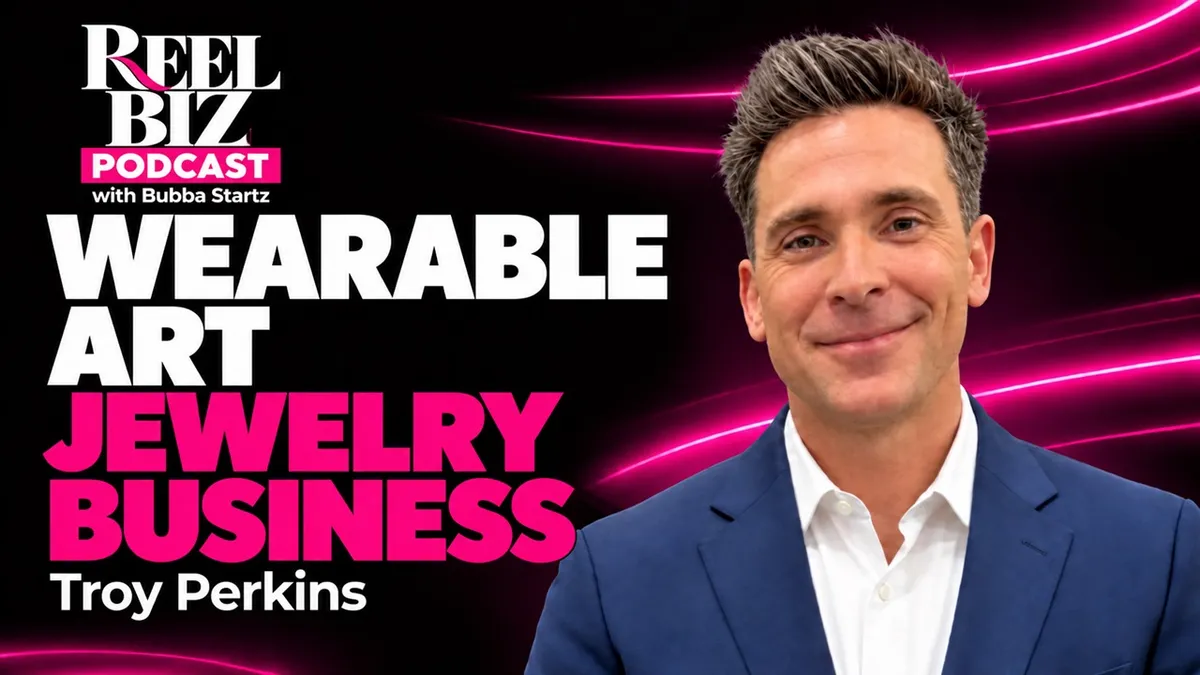
Troy Perkins on Estate Jewelry, Gold Prices and Building Platinum 1911
Wearable Art in a $5,000 Gold Market: How Troy Perkins Built Platinum 1911 by Buying Right and Working Hard
When the price of gold makes headlines, most people picture bars in a vault. Troy Perkins pictures a grandfather's ring, a brooch nobody wears anymore, and a family story that deserves another life.
Perkins is the founder of Platinum 1911, an estate jewelry, diamond, watch and bullion dealer based in Scottsdale, Arizona. He sat down with host Bubba Startz on this week's episode of REEL BIZ to talk about giving up the security of a paycheck, how a secondhand jeweler makes money whether the economy booms or busts, what record gold prices mean for everyday buyers, and why recycling old jewelry is quietly one of the greenest moves in the business.
Watch the full conversation on YouTube, stream it on Apple Podcasts, or find it on the REEL BIZ episode page. If you own a business, sell a product with emotional value, or have a jewelry box full of pieces you never wear, this one is worth your time.
Listen to the full episode:
From Beach Bum to Estate Jeweler
Perkins' path into jewelry was anything but a straight line. He grew up in Phoenix and Scottsdale, earned his business degree from Northern Arizona University in three years, spent a year at fashion school at FIT in New York City, started an MBA at the University of Texas in Austin, then dropped out and moved to Newport Beach "to be a beach bum."
One of the jobs he picked up there was high-end personal training. A client happened to be a jeweler, and Perkins ended up working for her company for six and a half years. Then a family friend taught him the estate business.
"At first, I was reluctant, who would sell old jewelry," he told Startz. "Then once I learned it, I fell in love."
He has now been in jewelry for twenty years and in estate pieces for about fifteen, including a stretch working for a large dealer before going back out on his own roughly six and a half years ago. Through it all, his priorities have stayed the same: "God first, family second, and then work. And I call, you know, work is play because I always enjoy what I'm doing."
The Paycheck Is Addicting
Startz, who spent years as a factory welder before going all-in on The Scene Projects, asked Perkins about the difference between working for a dealer and working for himself. Perkins didn't sugarcoat it.
"That paycheck is nice. That paycheck is addicting too because when you go out on your own, there is no... Like, you are your paycheck," he said. "So it definitely is hard, and most people are afraid to not have that paycheck."
The flip side is the ceiling disappears. "Working for yourself, I mean, the sky's the limit," Perkins said. "I'll work days on end and make no money. And then my jewelry sits, and I can make a bunch of money while I'm sitting on the beach with family on spring break. So that's where entrepreneurship, depending on your business, you get all the risk, but you also get all the reward."
He also had advice for anyone still on a payroll, and it's simple enough to start tomorrow: "Show up five minutes early, leave five minutes late. It doesn't take a lot." Learn your job so well that you can ask to help with someone else's, because "as an employee, you have the opportunity to learn somebody else's business while you're getting paid." Perkins has set up bounce houses, caddied, and worked as a janitor, and he says every one of those jobs taught him something.
The Secret Is There Is No Secret
After years of working alongside other business owners, Perkins has landed on a blunt conclusion. Most of them don't have anything he doesn't have.
"There's not some secret," he said. "The secret is hard work and taking action. A lot of people are caught up in inaction, and they're caught up with busyness." His gut-check for anyone who thinks they don't have time: look at the weekly screen time report on your phone. "If you see that you're spending eight hours a day on your phone and those aren't business hours, like, what are you doing with your life? If you take action and you're passionate about something, you will be successful."
Startz pointed out that the people who look like overnight successes rarely are. Perkins agreed. "Someone may see me now and say, oh, look at you. You're just an overnight success," he laughed. "I started this twenty years ago in jewelry. Whoa. I don't feel that old."
Making Money in a Boom and a Bust
The heart of the episode for business listeners is how Perkins has positioned Platinum 1911 to win in almost any economy.
"I'm in a unique spot being in secondhand jewelry, so I can make money kind of in a boom and in a bust," he explained. "When the economy is doing well, people are buying jewelry. When the economy is not going well, they're selling jewelry. So I can make the money on the buy."
With gold prices surging over the past year, that buy side has been busy. "There's so much gold and jewelry coming," Perkins said. The margins are thinner, but the volume is huge.
High prices also change who's shopping. "If you have a $1,000 and you wanna buy your wife a piece of jewelry in gold, you don't get a lot," he said. Right now, the pieces moving fastest for him are in the $5,000 to $30,000 range.
Perkins also trades bullion for clients who want to move money into or out of gold and silver. He recently handled a deal for 100 one-ounce gold coins, about half a million dollars in metal. The model is simple: buy slightly under the price he can sell at, earn a few percentage points, and solve a problem for both sides.
Gold Is a Hedge, Not a Paycheck
When Startz asked whether people should be buying gold, Perkins gave an answer you rarely hear from someone who sells it.
"I am not someone that says, hey, you need to put money in gold. Look, gold doesn't make money. It doesn't pay a dividend," he said. "When it goes up, you have to sell it to make that money. So I definitely think it's a good hedge. I do have a lot of my wealth in gold, but it's mainly in jewelry because I can make a better margin than just the gold going up."
His order of operations: "Invest in yourself first. Once you have money, yeah, you should diversify with some of the gold." (As always, REEL BIZ isn't financial advice. Talk to a licensed advisor before making investment decisions.)
He also explained why gold matters far beyond jewelry: it conducts electricity well and holds up over time, so electronics makers coat components in ultra-thin layers of it. Multiply that by tens of thousands of devices a day and it adds up.
Black Hills Gold and the Real Cost of Mining
Startz brought his own gold story to the table. He grew up in Lead, South Dakota, home of the former Homestake Mine, once one of the deepest and most productive gold mines in North America and now the Sanford Underground Research Facility. He watched what falling gold prices in the late 1990s did to his hometown.
Perkins broke down the math miners live by. If it costs $1,000 to pull an ounce out of the ground, gold has to sell for more than that to make the mine viable. And gold rarely comes out as nuggets. "If you have a one ton or 2,000 pounds of dirt, sometimes they're microscopic dots in the rock," he said. "They have to crush it all down, then extract it."
He has bought and sold Black Hills gold too. In his experience it's typically 10 to 12 karat and multi-toned, with the region's signature leaf-and-grape designs worked in several shades of gold.
The Greenest Jeweler in the Room
Perkins also talked about a side of his business that rarely gets any attention.
"I'm basically a recycler. So I put new life into jewelry," he said. "If I can take an ugly piece and take half of it, maybe I scrap half, the other half, I make into a new piece. What I do is pretty green." Many dealers he buys from would simply melt pieces down if he didn't step in, so they send him packages daily, knowing he'll pay a premium to keep good jewelry alive.
That often means what the trade calls a "marriage," joining or reworking pieces to make them wearable again. One customer recently told him she'd buy a brooch if it were a ring. "I'm like, done," Perkins said. The finished ring came back that morning. "It may sit for years as a pin, but now that it's a ring, it's gonna get on someone's hand and in their collection and put smiles on their face."
He's also honest with customers about what doesn't work. A common request is to melt down old family gold and recast it into one new piece. In reality, refiners melt gold hundreds of ounces at a time, and mixing different alloys "may not cast correctly." Some jewelers just tell customers what they want to hear. Perkins would rather tell them the truth.
For anyone confused by karats, he gave a quick lesson. 24 karat is pure gold. 18 karat is 18/24, or 75 percent gold. 14 karat is about 58.5 percent, and 10 karat is roughly 41.7 percent. The rest is copper, nickel, palladium or other metals, which is why lower-karat gold comes in different colors. You can go deeper in Platinum 1911's estate jewelry guide.
Every Day Is a Treasure Hunt, and Every Day There's a Fire
Asked about his favorite part of the job, Perkins didn't hesitate: "Every day, I don't know what I'm gonna get." A package in the mail, a seller walking into the office, a surprise in a dealer's back room. He buys six days a week, and sometimes on Sunday by text.
The hardest part is people. With 17 or 18 employees, "every day, there's a fire." That morning, one of his team members had been in a car accident, and Perkins was helping cover his rides to work. "I wanna help people," he said. "At least the excitement of seeing new pieces outweighs all the challenges."
He also explained why reality TV never fit. A previous company he worked for had talked with TV producers about a pawnshop-style show, but Perkins passed. In his view, those shows "paint everybody in the negative light."
Connect With Troy Perkins
Shop estate jewelry, diamonds and watches: platinum1911.com · Estate jewelry collection
Sell your jewelry or gold: Sell your unwanted jewelry for cash. Perkins says you can email him photos, and if you agree on a price he'll send a shipping label and pay you right away, or mail your piece back if you don't.
Appraisals: Insurance and estate appraisals
Visit the showroom (by appointment): 14807 N 73rd St., Suite 104, Scottsdale, AZ 85260 · 480-442-1567 · [email protected] · Contact page
Follow along: Instagram @platinum.1911 · Pinterest · LinkedIn · eBay store · Platinum 1911 blog
Catch the full episode of REEL BIZ with Troy Perkins on YouTube and Apple Podcasts, and explore more conversations with founders, creators and industry leaders at reelbiz.thesceneprojects.com.


