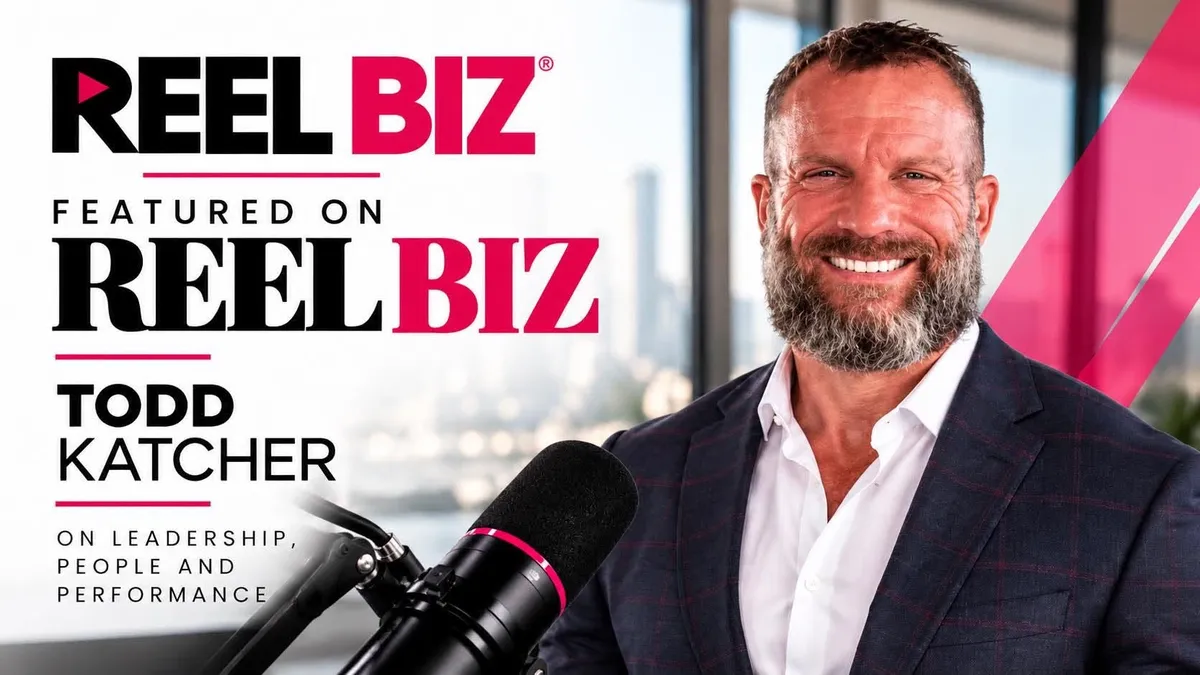
Todd Katcher on 20 Years of Digital Signage: From Nashville Bars to 2,500 Dealerships
The Silent Salesperson: How Todd Katcher Built a 20-Year Digital Signage Empire — and Gave the Tech Away to Animal Rescues
Walk into almost any business in 2026 — a car dealership, a gym, a doctor's waiting room, a Vegas casino — and you'll find a screen talking to you. Twenty years ago, that wasn't the case. Todd Katcher was one of the people who changed it.
Katcher, the founder of Digital Dealership System and chief product officer of Zoney Digital Signage, sat down with host Bubba Startz on this week's episode of REEL BIZ to talk about building screens by hand on his condo floor, why the best digital sign is a "silent salesperson," where XR fits into the future of in-store marketing, and how he turned two decades of tech into Matching Paws, a free platform for animal rescues.
Watch the full conversation on the REEL BIZ YouTube channel or stream it on Apple Podcasts. Here's why it belongs on the radar of every business owner, marketer, and creator who has ever spent money getting customers in the door — and then wondered what happens once they're inside.
A Bar in Nashville, a Question From a Car Dealer
Katcher's origin story doesn't start in a boardroom. It starts in a bar.
Around 2006, a friend visiting West Palm Beach, Florida, from Nashville pitched him on investing in a Nashville bar. Katcher bought in, parted ways with the business partner shortly after, and moved to Music City — "changing my life completely," as he put it.
Within a couple of years he'd launched a digital sign company with more than 100 installations across Nashville bars and restaurants. Then a customer asked a question that rerouted the next two decades: would he put the same platform in an auto dealership?
"Fast forward about twenty years later, and here we are," Katcher told Startz. Digital Dealership System now counts more than 2,500 dealership installations, with clients including AutoNation, Lithia, and Group 1 Automotive.
Building the Future by Hand
What hooked Startz during their discovery call was how early Katcher got in — and how much problem-solving that required.
In 2006, there was no off-the-shelf digital signage. Katcher ordered components from China, built his own PCs, and designed custom frames to house the computers and TVs. Many venues had no Wi-Fi, so his network ran on Sprint cellular cards. When he moved into automotive, the commercial-grade NEC displays he bought ran at roughly 720p, weighed more than 100 pounds each, and had to arrive by freight truck weeks after ordering.
"At some point, I was making computers for our systems and customizing them on my floor in my condo and had 12 screens on a second bedroom wall," Katcher said. "It really is all about problem solving and just doing whatever needs to get done in order to deliver the results for our customers."
For REEL BIZ listeners building media companies today, that's the lesson: the tools will always change. The willingness to build what doesn't exist yet is what lasts.
Right Message, Right Person, Right Time
Ask Katcher what digital signage actually is, and he skips the hardware entirely.
"Providing the right message to the right person at the right time is really what digital signs are all about," he said.
Inside a dealership, that means designing for dwell time — how long a customer stays in a given zone. A guest spends under ten minutes in the service drive, but 60 to 75 minutes in the customer lounge. The showroom needs energy and video walls. Behind the scenes, staff need motivation. That thinking produced Digital Dealership System's full suite: customer lounge TV with a patented commercial-replacement feature, service drive digital signs tied into the dealer's DMS, showroom video walls, and the PULSE KPI leaderboards that replace the old dry-erase sales board. Katcher has made that case to the industry repeatedly, including in a CBT News interview on ditching the whiteboard and a NADA Show 2025 conversation on the PULSE rebrand.
The same principle applies to any business with a screen. Katcher's favorite example is a restaurant: the card swipe captures the contact info of the one person who pays, but not the other four at the table. Put a QR code or text-back number on screen, and suddenly you're growing your database — and filling slow Tuesday nights. "If you're still using an eight-and-a-half by 11 sheet of paper on the wall," he said, "you're stuck in the eighties."
The Silent Salesperson vs. the Ad Network
Startz zeroed in on a distinction most businesses miss. Many screens you see in the wild are ad networks — a provider installs a TV for free, then sells slots to other businesses. Katcher's model is the opposite: the silent salesperson.
"Imagine if they were advertising the MGM inside the Wynn," Katcher said. "It makes no sense. What does make sense is trying to capture as much of that mind share as possible." The new restaurant downstairs. Tonight's show. The upgrade you didn't know about. The screen sells your own business — without a salesperson saying a word.
Startz put it plainly: you can be upselling without having to upsell.
Zoney: Twenty Years of Enterprise Tech, Opened to Everyone
When Digital Dealership System outgrew every off-the-shelf platform Katcher evaluated, his team built their own. That platform became Zoney — a name Katcher has held for more than twenty years — and it has quietly powered DDS's enterprise network behind a white label.
This year, Zoney went public. Digital Signage Today reported in August that the platform officially exited stealth mode with multi-location screen management, a built-in drag-and-drop designer, and standard plans for customers with their own media players. Its flagship Zoney+ package bundles the software with a commercial-grade media player for a one-time payment — no monthly subscription — plus unlimited zones, 150+ apps and widgets, and AI content tools. Zoney serves restaurants, retail, fitness centers, events and venues, and more, and it's built for operators who want to launch their own ad network on a secure, enterprise-tested backbone.
"Because Digital Dealership System has the experience of thousands of screens, we wanted to make sure that we worked for enterprise level first," Katcher said.
Ask Before You Tell
The quality Startz admired most in Katcher isn't technical. It's curiosity.
When that first car dealer approached him, Katcher knew nothing about the auto business. His answer: "What would it do?" Two decades later, dealers still ask whether his family was in the car business. "No," he tells them. "I just learned by listening."
That habit built DDS into a 20-plus-product company — almost every product exists because a dealer asked for it. Katcher still drills it into his team: ask questions before telling someone how to do something. Startz connected it to his own evolution at REEL BIZ, where every discovery call now starts with one question for the guest: what do you want to get out of this?
XR, Digital Signs, and the Portal Problem
As someone active in the XR world, Startz asked where augmented and virtual reality fit into the future of signage. Katcher's answer was refreshingly practical.
At InfoComm, he saw retail demos where shoppers scan a QR code and build an outfit on a 75-inch screen — brilliant until a second shopper shows up and has to wait. "The problem with these things is the usability, not the technology," he said.
His vision: the screen becomes a portal. Scan a QR code with smart glasses and you're suddenly sitting in a vehicle for a virtual test drive, or browsing inventory — while 100 other people in the same showroom have their own private experience at the same time. Startz summarized it neatly: right experience, wrong delivery — until the delivery scales.
Staying Ahead Without Getting Whiplash
Katcher keeps his social scrolling under an hour a day but spends hours on YouTube deep dives, weekly tech roundups, and conference keynotes. Even so, "I still feel like I'm behind," he admitted.
That learning has a business purpose. His 10-person office is getting formal AI training, because, as he noted, an untrained team can send a company's AI bill exponential. For media entrepreneurs scaling their own teams, that's a practical warning worth hearing.
Matching Paws: Free Tech for the Animals
The episode's heart came at the end. Katcher has worked with animal rescues for more than twenty years, including with Big Dog Ranch Rescue, one of the country's largest rescues, based in South Florida. Out of that work came Matching Paws.
On the adopter side, Matching Paws lets people search adoptable animals — dogs and cats, plus horses, birds, and even donkeys — from rescues nationwide, alongside a vet directory, pet insurance partners, shopping links, training resources, and foster and volunteer opportunities.
On the rescue side, it's a full back office at no cost: around 20 website templates with custom domains, a CRM, and tools to manage adoption and foster applications. Instead of charging rescues, the platform adds a small fee — a dollar or two — to donations and adoptions.
"Anytime that they have to spend any money on their own, that's money that's not going to the animals," Katcher said.
Startz, a lifelong animal lover who serves as Director of Marketing and PR for Operation Combating Veteran Suicide, related to the mission instantly — and promised Katcher a few introductions to rescue leaders in the REEL BIZ network. Rescues can register here.
Connect With Todd Katcher
Digital Dealership System: digitaldealershipsystem.com · schedule a demo · [email protected]
Zoney Digital Signage: zoney.com · start a free trial
Matching Paws: matchingpaws.com · matching paws blog
Personal Website: toddkatcher.com
Todd's Podcast Appearances: toddkatcher.com/podcasts/
Catch the full episode of REEL BIZ with Todd Katcher on YouTube and Apple Podcasts, and explore more conversations with founders, creators, and industry leaders at reelbiz.thesceneprojects.com.


