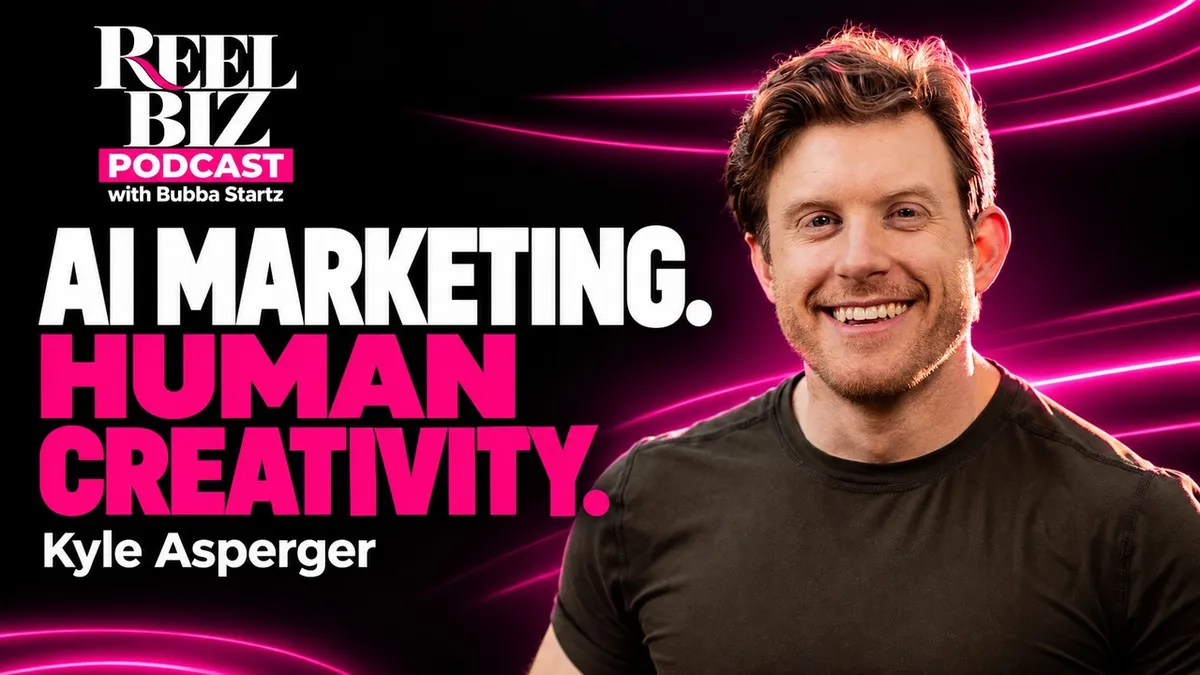
Kyle Asperger on Human Connection, AI and the Creative Reset
The Creative Reset: Kyle Asperger on Why Marketing Still Comes Down to One Human Talking to Another
Scroll any feed for five minutes and you'll see it: the same AI-generated flyer, the same caption formula, the same polished sameness. Kyle Asperger has spent a decade in marketing, and he thinks that sameness is opening a door for the people willing to stay human.
Asperger is the founder of Denver brand experience studio Studio 301, a marketing coach behind Anarchy For A Day, and a working actor. He joined host Bubba Startz on this week's episode of REEL BIZ for a wide-ranging talk about what AI is taking away from marketing, what it can't touch, and why the age of the independent creator demands a new kind of community.
Watch the full conversation on YouTube, stream it on Apple Podcasts, or visit the REEL BIZ episode page. If you're a creator, a small business owner or a marketer wondering where you fit in an automated world, this is your episode.
Listen to the full episode:
From La Grange to Denver, With a Detour Through Agency Life
Asperger grew up in La Grange, in Chicago's southwest suburbs. He was adopted, and that part of his story is built into his company's name: the "301" in Studio 301 comes from 301 S Waiola, the address of the home he was adopted into, and the studio's approach is shaped by his adoptive parents' example of service.
He lived in Columbus, Ohio, for about seven years before landing in "beautiful, gusty Denver, Colorado." With a degree in graphic design, he built a marketing career and ran his own agency for nearly a decade, serving clients such as Highlights for Children, True Lemon and the Colorado Avalanche Information Center. Then he launched a coaching practice, right as generative AI was reshaping the industry.
"Probably the worst time to become a coach and or do anything further with marketing because AI is stealing everything," he joked. "So then I figured, you know what? I might as well just escape and, I don't know, try to play other people." That's how his acting career got started, and these days, as he puts it, "I'm just a dude that rises to whatever the occasion is."
The Chicago connection wasn't lost on Startz, who grew up nearby in Crest Hill and whose family roots run deep in nearby Romeoville. Two Southwest Suburbs kids, both now building careers around creativity.
Marketing Isn't Selling. It's Communication.
Startz pushed back early on the idea that AI is taking over marketing. AI can speed up design work, he said, but it can also drive a wedge between marketing and what it really is: a human connection.
Asperger agreed, and went a step further. He thinks the word "selling" is what gives marketing a bad name.
"The root disconnect... was communication. And this is a human to human thing," he said. "Even if it's business to business, regardless of B2B, B2C, it's still human on the receiving end."
In his agency years, most clients came to him with the same problem: they didn't know how to talk to the audience they wanted to reach. Experts want language that tells them you understand their world. Someone who doesn't yet know they have a problem needs it explained in a way they can absorb. "There's no one singular answer because all kinds of different people, we have a gazillion different platforms these days and all kinds of marketing tactics," Asperger said. "So it's like the root is human to human."
That's the lesson for any business owner: before you choose the tool, the platform or the prompt, get clear on who you're talking to and what they need to hear.
Will There Be a Human Uprising?
Asperger is a "huge, huge supporter of innovation," but he's honest about what automation has done to his field. A lot of what used to be enjoyable work has been handed over to machines.
He also thinks there's a breaking point ahead. "I don't know if all of a sudden humans are like, you know, I really do miss being sold to by other humans as opposed to robots pretending to be humans," he said. "Why not go back to it even though we fail, even though we're far less efficient? I feel like there will be, like, a human uprising at some point."
His reasoning is simple consumer psychology: "The moment that you start saying no to something, that's when people will say yes."
The Age of the Independent Creator
For Startz, who has interviewed hundreds of independent artists for REEL BIZ and The Scene Projects, this conversation hit home. The music industry, he argued, has cannibalized itself: consolidation, AI artists climbing the charts, and individual creators devalued to the point that many can't make a living doing what they love.
"It's unfortunate, but the age of the independent creator is upon us," Startz said. "And it's how do we build platforms together to use those to promote each other and our things."
Asperger, whose training ground was graphic design, theater and film, sees the same pattern in every creative field. "You know, the biggest are eating everybody," he said. "If you can't beat them, buy them. Just suck them in. But that does leave the little guy or girl."
That's why Startz is building The Scene Projects to reach down, not up: spotlighting artists who are just starting out and building a platform to "pull all of the people below me up onto so that we can build something greater."
Music With a Capital M
One of the most thoughtful parts of the episode was about how the way we listen has changed what music does.
Asperger described a trip to New York with his father, a lifelong jazz lover pushing 70, and trying to explain how music works today. Platforms built around individual creators allow for "hyper niche followings," he said, but something was lost along the way.
"Music from my dad's era, that was music with a capital M. That changed lives. That moved cultures in certain directions, and the music nowadays does not," Asperger said. Back then, people heard music together, at concerts, in bars, on the same radio stations, and shared it. Now it's "more of an individual experience," so even extraordinary work rarely creates a shared cultural moment unless people gather at a show or festival.
Startz traced his own first vivid music memory to hearing the Red Hot Chili Peppers' "Under the Bridge" on the radio in his family's Ford Aerostar, on the way to see his grandfather's boat on the Des Plaines River. Those moments, he argued, are harder to come by now that radio is owned by conglomerates, many DJs have been replaced by automation, and the charts feel locked in place. As one industry commentator he follows put it, the Billboard charts used to be like an amusement park ride where everyone eventually got a turn at the top. "Now it's just the same VIPs on rotation."
When Everyone Uses the Same AI, Everyone Looks the Same
That flattening shows up in marketing too. "Because everyone is using the same AI, everyone's marketing ends up looking exactly the same as well," Startz said. "I see the same flyer now 400 times as I'm scrolling."
For independent artists and small businesses, that's both a warning and an opportunity. If every competitor's flyer comes out of the same tool, the one built with a real point of view, a real voice and a real story stands out.
It's also why The Scene Projects runs an academy built around a team of coaches rather than a single guru, and why Startz would like to add a marketing coach to that team someday. "They're so busy creating that a lot of them forget that, well, you also need to know how to bring yourself to the market," he said.
The Power of the Whole
Asperger shared the image that became the center of the episode. Scuba diving in Costa Rica a few years ago, he saw plenty of colorful sea life. But the moment he never forgot was being surrounded on all sides by a school of plain gray fish.
"The fish themselves weren't terribly interesting. But when you think about it from the holistic perspective being completely surrounded by them, easily one of the most impactful experiences in my life," he said. "So that is just to say the power of the whole shan't be discredited even when it comes down to the literal small fish."
Startz loved it, because it described exactly what he's trying to build: individuals moving on their own, but as part of something much bigger.
Follow What Feeds the Kid in You
With job losses piling up and many people rethinking their careers, Asperger closed with advice that explains his own move into acting.
"I like pretending I'm other people. What am I doing? I'm playing pretend. It's nothing different that I wasn't doing as a kid," he said. "Whatever it is that feeds the child in you, your soul, call it what you want, sometimes that's a great avenue. Just go explore it."
Connect With Kyle Asperger
Studio 301 (brand experience design, storytelling, video and photography): studio301.org · About Kyle and Studio 301
Anarchy For A Day (marketing coaching): anarchyforaday.com
Facebook: search "Kyle Asperger 301," the handle Kyle shared on the show
Hear more from Kyle: Anarchy for a Day, with Kyle Asperger on The Neil Wilkins Podcast · Kyle's articles on MarketScale
One tip from Kyle if you reach out: "Give me something that I can actually respond to. Don't hit me with just a hi."
Catch the full episode of REEL BIZ with Kyle Asperger on YouTube and Apple Podcasts, and explore more conversations with founders, creators and industry leaders at reelbiz.thesceneprojects.com.


