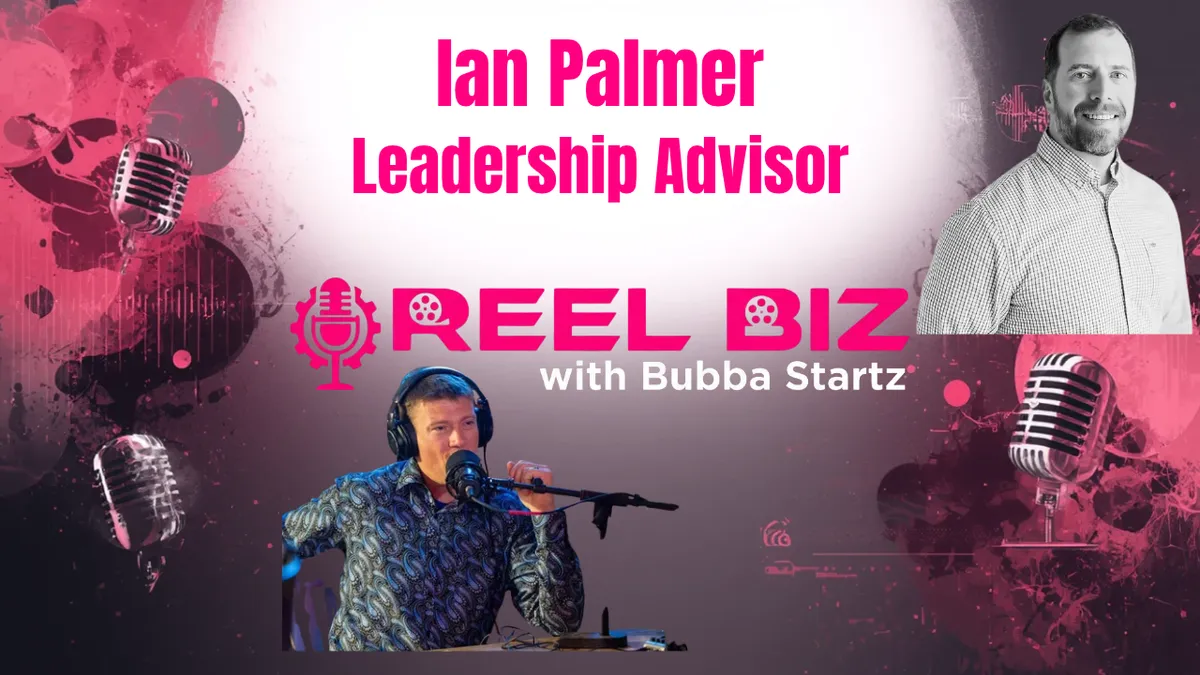
Ian Palmer on Coaching the Coaches: Leadership Lessons from 26 Years in the Army
Coaching the Coaches: How Ian Palmer Turned 26 Years of Army Command Into a Championship Culture Business
Every coach knows the scoreboard. Far fewer know how to build the thing that moves it. That gap — between being great at X's and O's and being great at leading people — is exactly where Ian Palmer has built his business.
Palmer, a retired U.S. Army Colonel and founder of Ian Palmer Leadership, sat down with host Bubba Startz on this week's episode of REEL BIZ to talk about life after 26 years in uniform, the leap from leading soldiers to advising coaches, and why the word "win" is nowhere in the framework he uses to help programs win.
Watch the full conversation on the REEL BIZ YouTube channel or stream it on Apple Podcasts. Here's why it's required listening for coaches, athletic directors, and anyone who has ever been promoted into a leadership role without a playbook for it.
Listen to the full episode:
From Youngstown to Notre Dame to the World
Palmer's story starts in Northeast Ohio, just north of Youngstown. An Army ROTC scholarship took him to the University of Notre Dame, where he met his wife, Missy. A week after graduation he was on active duty — and he didn't come off it for 26 years.
The résumé is serious. According to his official bio, Palmer commissioned as an Armor officer, commanded from platoon through brigade combat team, served in Joint Staff assignments at the Pentagon, deployed to Iraq and Afghanistan, and finished his career as Chief of Staff of III Armored Corps — an organization of roughly 90,000 people across five installations. He holds graduate degrees from the U.S. Naval War College and LSU and was a National Security Affairs Fellow at Stanford's Hoover Institution. A Field Grade Leader profile from earlier in his career captures the same philosophy he brings to athletics today: leaders can't succeed alone, and their real job is to delegate, manage, and develop the people beneath them.
Along the way, he and Missy raised seven children — and welcomed their first grandchild this past May. "Both my wife and I came from big family, so that's what we were used to, and we are truly blessed," Palmer told Startz.
After retiring at the end of 2023, Palmer moved outside Lexington, Kentucky, spent two years with a leadership consulting firm, and roughly a year ago launched his own company focused squarely on coaches and leaders in the athletics community.
Leadership Through the Lens of the Locker Room
For Palmer, the move into sports wasn't a pivot. It was a homecoming.
"I played every sport I could," he said. "The year revolved around what sports season's going on." Football, baseball, basketball, soccer — and the coaches behind those seasons became the first leadership models he ever studied.
"When I started my army service, I approached it very much like an athletics team because so many of the leaders as I was growing up were coaches," Palmer explained. Whenever anyone asked what he'd be doing if he weren't in the Army, the answer never changed: "I would be a coach. Specifically, I wanted to be a high school football coach. I love Friday night lights."
After nearly three decades away from the sideline, jumping straight into tactical coaching wasn't realistic. So Palmer found the lane where his experience mattered most — not coaching the team, but coaching the people who coach the team. "I have always viewed the first priority of any leader is to create more leaders," he said.
The Promotion Problem Nobody Trains You For
One of the sharpest insights from the episode applies far beyond sports. Across almost every profession, Palmer said, people get promoted for one set of skills and then discover the new job demands a completely different set.
"If you're good at X's and O's, you're good at tactics, you'll get promoted in positions where you're put in charge of other people, but that's not the same skill set that you need when you get there."
Startz connected it directly to the NFL, where elite offensive and defensive coordinators routinely stumble in their first head coaching job. Palmer agreed and pointed to the shift from a narrow unit focus to what the Army calls the "up and out" — program-level and franchise-level responsibilities that never existed in the coordinator's room.
He also named the most common mistake he sees in first-time head coaches: trying to be the coach they worked under instead of finding their own voice.
"The view of the seat is different than the feeling within the seat," Palmer said. "When you're the one put in charge of driving the culture, of developing others, of making the difficult decisions, it feels a lot different when you're doing it than when you're watching somebody else do it."
His fix is preparation in parallel: be the best assistant you can be today while deliberately building your coaching philosophy, your vision, and your approach to accountability for tomorrow. That's what he calls defining your leadership voice — because, as he put it, "we're all gonna lead differently because we're created differently."
The Competitive Greatness Method
Every engagement starts with discovery conversations, and the work is tailored to each coach or program. But the backbone is a system Palmer calls Creating Championship Culture, branded on his site as the Competitive Greatness Method.
The name comes straight from John Wooden's Pyramid of Success, where "Competitive Greatness" sits at the very top.
"Why I love that so much is because nowhere — John Wooden, who did a lot of winning — nowhere do you see the word win in his pyramid of success," Palmer said. "It's about focusing on developing people, being good people, having good systems and processes, being the best version of yourself, and the output is competitive greatness."
The method is process-driven and built around what a program can actually control: How do you live well? How do you lead well? How do you treat your people well? How do you create positive culture? Do that consistently, and you set the conditions that most reliably produce wins.
Startz summed it up: winning is a result, not the starting goal. Palmer added a warning that every athletic director should hear — "If you focus on winning, then there's a lot of different avenues to get there, and not all of those are great."
Why Assistant Coaches Are Where the Impact Lands
Asked where his work has hit hardest in year one, Palmer didn't hesitate: assistant coaches.
"Assistant coaches are leaders as well," he said. "We're not just focused on assistant coaches to create head coaches. We're focused on assistant coaches to help create better leaders who may someday become a head coach."
What sets that group apart is appetite. Palmer has seen more curiosity, more hunger, and more growth mindset among assistants than among head coaches — which makes them the ideal audience for reflection-driven development that pays off now and compounds later.
A Business Built on Trust, Not Cold Calls
For the REEL BIZ audience of founders and creators, Palmer's go-to-market approach may be the most useful takeaway of the episode. He doesn't cold call. He doesn't spam LinkedIn. He builds through relationships — the same way he and Startz were connected through mutual friend Tim Neiman, who Palmer has also featured on his blog.
"I'm not a cold call guy," Palmer said. "It's gotta be based on a trusted relationship. If you were to say to a coach, 'Hey, I've worked with Ian. It's been really valuable,' that's much more powerful than me sending you a cold LinkedIn message."
One strong relationship leads to two or three more coaches, and those open the next doors. In a trust-based service business, referrals aren't a tactic — they're the whole model.
Telling Your Story Is the Work
The conversation's most resonant moment came when Palmer explained how running his own company forced him to capture decades of lessons he'd never written down. He now publishes a blog every couple of weeks, along with a weekly newsletter and videos — recent posts include Accelerating Trust: What a Coach Can Build Before November and Leadership Presence: Going to the Point of Friction.
"It's forced me to write things down, to organize my thoughts," he said. "How did the theory meet the practice, or how did the science meet the art, and what was the result?" Many of the models he uses with coaches today started exactly there — with a story and a memory.
That same reflection is where his one-on-one work begins. "How did you get here? What happened in your life, good and bad, that shaped you?" Palmer asks his clients, before helping them translate that story into values they can communicate and lead with. It's a habit he developed in the Army, meeting young soldiers from Puerto Rico, Guam, and everywhere in between. "I would just love to hear where-you-came-from stories," he said. "That's gonna shape how you see the world and how you lead."
Startz, who has conducted roughly a thousand interviews in the last few years, recognized the same engine behind podcasting — and behind REEL BIZ's recent momentum, with monthly downloads jumping from about 1,600 to more than 7,800 in a single 30-day window. Deep conversations still win in a scroll-first world.
Passing the Gift On
Palmer isn't planning an exit. "I have a passion for leadership. I have a passion for athletics," he said. "I want coaches to give to their other coaches and players the same thing that I got through good coach leadership." Someday he and Missy may buy an RV to visit grandkids across the country — but the mission travels with them. "The gifts I've been given, I wanna pass on to other people."
Connect With Ian Palmer
Whether you're a Division III assistant or a veteran head coach, Palmer's advice is simple: start at ianpalmerleadership.com. Discovery calls are free — "I don't charge anybody for a call," he said — and you can book one directly here. Not ready to talk? Sign up for his weekly stories at ianpalmerleadership.com/newsletter.
He also answers on every platform: Instagram, LinkedIn, X, Facebook, and YouTube.
Catch the full episode of REEL BIZ with Ian Palmer on YouTube and Apple Podcasts, and explore more conversations with founders, creators, and industry leaders at reelbiz.thesceneprojects.com.


