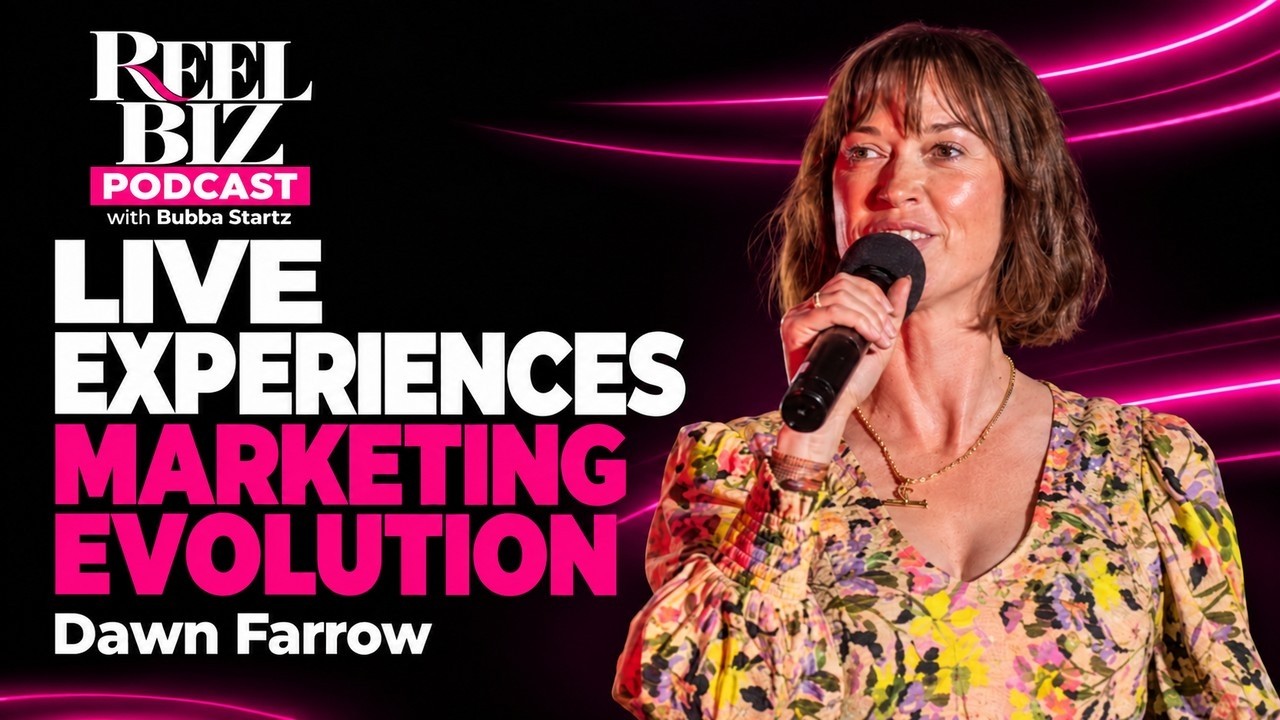
Dawn Farrow on Experience Marketing and Selling Live Events
Put the Marketer in the Room First: Dawn Farrow on Selling the Experience Economy
Every performer knows the feeling. You rehearse for months, book the room, tune the guitar, and walk out to half-empty seats. Dawn Farrow has spent more than twenty years on the other side of that problem, figuring out how to fill the room before the curtain goes up.
Farrow is the founder of On Sale Group, which runs the On Sale Live expo for the people who sell tickets to theatre, immersive shows, attractions and music, and the GIEM Experience Marketing Masterclasses. She joined host Bubba Startz on REEL BIZ, "speaking to you from a very rainy and dark London," to talk about why marketing gets forgotten, what actually sells an experience, and where podcasts fit into the mix.
Watch the full conversation on YouTube, listen on Spotify or Apple Podcasts, or visit the REEL BIZ episode page. If you've ever spent more on gear than on getting people through the door, start here.
Listen to the full episode:
From Dancer to the Producer's Office
Farrow moved to London to perform. "My background is a childhood of dreaming to be on the stage and literally wanting nothing more than to perform," she said.
Life had other plans. During her professional training she landed in a theatre producer's office and started marketing musicals, including Cats and Starlight Express. She went on to market plays, then immersive experiences, large-scale comedy tours and arena events.
Then came the entrepreneur's itch. "I shouldn't work for somebody else. I'll go build my own marketing agency," she said. That agency "turned over millions of pounds, specifically working with what we now call and now refer to as the experience economy." Just before Covid, she decided to close it, a move she calls "incredibly well timed."
Today she consults on major global ticketed experiences "such as the Friends Experience or Netflix's Squid Game." By her count in a Run Riot interview, her campaigns have helped sell more than 36 million tickets.
Building a Home for the People Who Sell Tickets
Alongside the consulting, Farrow saw problems and opportunities in her own community of sales, marketing and communications professionals. On Sale Group was her answer, and it works two ways.
The first is On Sale Live, an annual in-person gathering every May. When she recorded this episode, the next edition was headed to King's Cross in London. "There's over 300 of us that come to network, learn and share," she said. The event has since grown into On Sale Live: The Experience Economy Expo, set for 11-12 May 2027 at the Business Design Centre. Entrepreneur UK named On Sale Live to its UK100 Start-Ups list in 2026.
The second is training through the Global Institute of Experience Marketing, or GIEM, where marketers learn how to sell more tickets. "We train them in psychology of selling," Farrow said, along with AI for selling tickets and other areas of advertising and ticketing. The course outline covers customer psychology, search and AI visibility, advertising and ticketing technology.
"Put Us at the Beginning of the Conversation"
Startz, a songwriter himself, knows the gap Farrow is trying to close. Plenty of independent acts will rent a bigger venue and leave nothing for marketing. "Nobody's gonna care about your $2,500 guitar if there's nobody in the crowd to care," he said.
Farrow's diagnosis: marketing usually gets called in too late. Often, she said, it's forgotten until "we haven't sold enough tickets or got enough bums on seats and then we start to go, oh gosh, like what should we have done?"
Her fix is simple. "Just put us at the beginning of the conversation. Let's talk about the venues you're going to. Let's talk about their database. Let's talk about how your vision for being an artist ties into their programming vision. And are we aligned?"
For any musician planning a tour, ask those questions before the first deposit is paid.
Same Show for Two People or 2,000
As a former dancer, Farrow understands the performer's mindset. "It doesn't matter if there's two people in the crowd or 2,000 people in the crowd. It's the same performance when it is happening," she said.
But guaranteeing those people is getting harder, and everyone is doing more with less budget. Music in particular lives and dies by fandom. "The problem with fandom is it's so flipping fickle," she said. "And maybe that's why sometimes it's just easier to go out and buy a new guitar."
It's also why she calls it experience marketing, a discipline of its own. Great marketers from outside the live world often "stay in our industry for a nanosecond," she said, because the pressure and emotion are so intense. Part of that pressure is personal: "We wanna do a great job so that when you go out on stage, you feel good."
Selling a Feeling Before Anyone Has Felt It
Startz asked the obvious question: how do you sell something less tangible than a product? Farrow's answer is social proof.
"We absolutely rely on this kind of social proof," she said. "Testimonials, quotes, reviews, they're so important to selling experiences. But that only works once you're up on the road and once you're open."
That's the hard part. Before a show opens, marketers have to convince people "it's worth taking three hours out of your weekend, or it's worth getting the babysitter, or it's worth trying to get a group of friends together."
Short-form video is now a big part of that, though Farrow questions why. "What I can't work out is whether we're being pushed into that because essentially the Meta algorithm says this is what we want to serve," she said. Influencers help as another form of social proof. Still, "we talk a lot about actually needing to build the brand, which, you know, can't necessarily just be achieved through video."
Seen, Heard, Understood
Follower counts used to be the goal. That has changed.
"What we talk about a lot is being seen, heard, understood," she said. Those are the three things to think about every time you post for the community you want to serve. "I'm not liking a video because I've seen how many people follow you," she added. "If we feel seen, heard or understood in the content you put out, it feels like it's for me, and I think I'm going to interact with it."
Where Podcasts Fit
Then Startz asked the question closest to home. Farrow didn't hesitate. "I think podcasts are a phenomenal way of building brand awareness," she said. They give a brand room to explain its message in a way an ad can't.
When she plans a campaign, podcasts sit right next to the established broadcast channels. "I look at broadcast and I go, okay, is it podcasts? Is it radio? Is it video on demand? Or is it terrestrial, you know, traditional TV advertising?"
Startz added a reality check: REEL BIZ won't deliver millions of followers overnight, but it gives guests well-produced content to share with their own communities.
Why Live Is Getting More Valuable, Not Less
Farrow pointed out that the experience economy is no niche hobby. She cited forecasts that put its value at $12 trillion by 2028. "We're not some, you know, tiny little industry that doesn't know what it's doing," she said.
Startz, who takes his own show on the road with live songwriter showcases, argued that AI-generated video will push people to tune out online and seek out physical communities. Farrow agreed. After Covid, she said, people wanted back into rooms: "What did people do when we came out of Covid, they did experiences."
"But we will never take away from being in person, especially when we see the rate of technology advancement," she said. "We will want to be in person more, and we will want to see authentic people, you know, doing their thing."
From Secrets to Sharing
Farrow's favorite topic was culture. Earlier in her career, she said, "I was very much trained to not share." You worked more hours than there were in a day, didn't complain, and "definitely did not share any information about what worked and what didn't."
On Sale Live flips that. "We've got theatre people next to immersive people, next to music people, next to attractions," she said, and they're asking each other what's working. She described it as "building one another up rather than that kind of older school approach." Startz summed it up with an old line: iron sharpens iron.
The Takeaways for Performers and Promoters
Bring marketing in early. Talk venues, databases and audience fit before you book.
Budget for seats, not just gear. The best guitar in the world can't fill a room on its own.
Collect social proof fast. Reviews and testimonials sell experiences, so gather them from the first night.
Aim to be seen, heard and understood. Content that speaks to your community beats chasing follower counts.
Treat podcasts as broadcast. Plan them alongside radio, video on demand and TV.
Connect With Dawn Farrow
On Sale Live expo and On Sale Group: onsale.live · On Sale Live 2027 tickets · Learn and connect, including the free On Sale Network WhatsApp community
Training: GIEM Experience Marketing Masterclasses · Course outline
Newsletter: On Sale Insider sign-up
Contact: onsale.live/contact · [email protected]
Social: @dawn.onsalegroup on Instagram. On LinkedIn, search "Dawn Farrow."
More from Dawn: The Experience Economy, AI and Selling Live Events on The Business of Show Business · On Sale Live 2026 review on blooloop
Catch the full episode of REEL BIZ with Dawn Farrow on YouTube, Spotify and Apple Podcasts, and explore more conversations with founders, creators and industry leaders at reelbiz.thesceneprojects.com.


