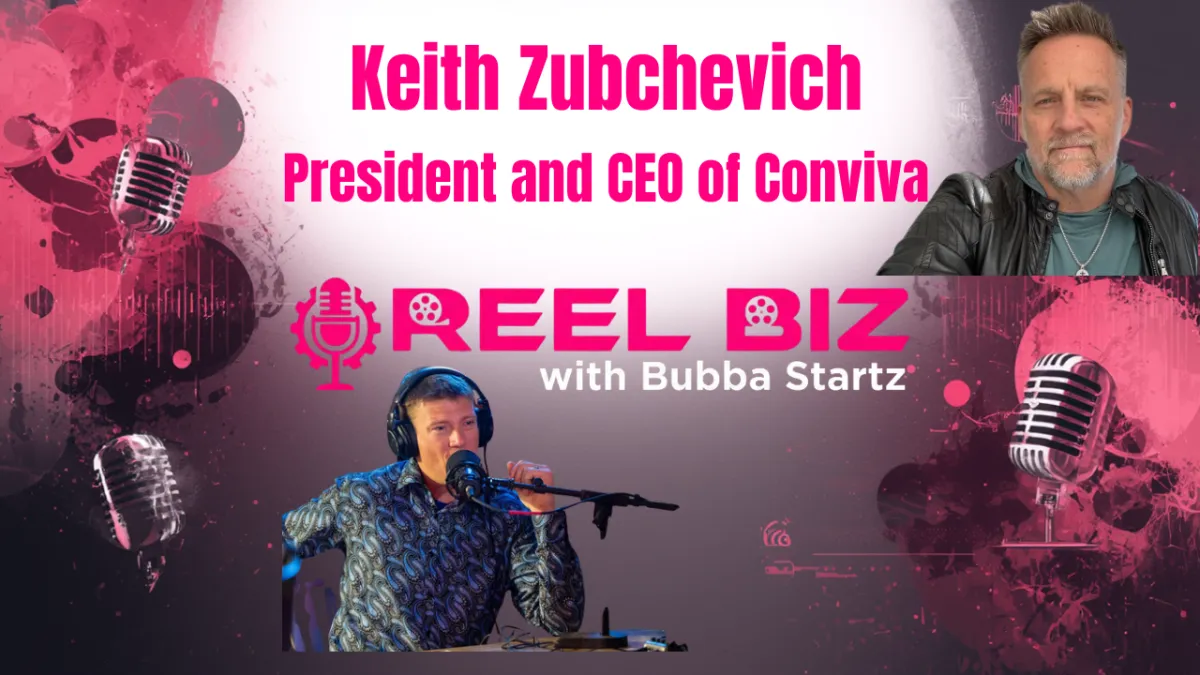
Conviva's Keith Zubchevich on Quality of Experience & AI
The Company Everyone Uses and No One Knows: Inside Conviva's 20-Year Bet on Quality of Experience
Watch the full REEL BIZ episode with Keith Zubchevich on YouTube » | Listen on the REEL BIZ podcast page »
Every time you stream the Super Bowl without a buffering wheel, watch the World Cup on your phone in perfect sync with your neighbor's television, or get frustrated with a customer service chatbot, there's a decent chance one company was quietly working in the background to make — or fix — that experience. You've never heard of them. That's by design.
On the latest episode of REEL BIZ, host Bubba Startz sat down with Keith Zubchevich, President and CEO of Conviva, for a conversation that started with streaming video and ended somewhere far more important to anyone building a business online right now: what happens when the same "quality of experience" problem that reshaped television comes for AI agents.
Twenty Years Before There Was Anything to Measure
Zubchevich didn't start at the top. He calls himself "the fifth Beatle" — the operator who joined Conviva's four academic founders nearly two decades ago after already building several companies to a liquidity event during a 35-year career in technology. The premise Conviva was built on was almost absurdly early: any business operating on the internet should be able to measure the actual experience it's delivering, not just system uptime.
The catch, as Zubchevich tells it on the episode, is that Conviva started measuring video before there was meaningful video on the internet to measure. Streaming, as an industry, didn't exist yet. What the founders understood was that the internet was never built for video, and that eventually somebody would have to sit between the source and the viewer and answer one question in real time: is this actually working for the person watching?
That single insight became the foundation for a company that, according to Zubchevich, has now launched 12 of the 15 largest streaming apps in the world and sits on roughly 8 billion devices globally.
Why "System Performance" Is a False Flag
One of the most useful frameworks Zubchevich lays out on the episode is the difference between QoS (quality of service) and QoE (quality of experience) — and why most companies still confuse the two. A server can report 100% uptime and a viewer can still be watching what Zubchevich bluntly calls "Minecraft" — a blocky, buffering mess. System-side metrics, in his words, have "very little correlation" with what a human being is actually experiencing on the other end.
That distinction is why HBO, one of Conviva's earliest customers, came to the company in the first place: building a streaming product meant nothing if it couldn't deliver the same TV-quality experience audiences already associated with the brand. As Zubchevich put it, "I don't get to be HBO online. I'm still HBO."
The World Cup, the Super Bowl, and 70 Million Reasons Scale Matters
Zubchevich shared some staggering numbers from recent events: Conviva tracked 70 million concurrent viewers during World Cup weekend, feeding quality data back to publishers in real time across billions of sessions. It's the same story for the Super Bowl and the Olympics — events where, in Zubchevich's words, the "ankle biter" quality-of-experience vendors simply fall over. A slick dashboard is one thing; surviving a single, one-to-one measurement of tens of millions of unique streams — each one traveling a different, unpredictable path across 50 different networks and CDNs — is another.
That complexity is the real story behind why streaming is fundamentally harder than the cable era it replaced. Cable delivered a single signal, on a dedicated network, to a hardware device. Streaming turns your television into unreliable software, competing for bandwidth on the same open internet as your email and security cameras — with a unique, individual stream for every single viewer. For a deeper look at how Conviva instrumented this exact challenge during a live global event, Conviva's own writeup on agentic analytics at the 2026 World Cup is worth a read — it details how the company's AI agent, Nexa, helped broadcasters flag and resolve concurrency issues in real time rather than waiting on next-day reports.
"Better Platform, Better Data, Better Agent"
The most quotable — and most useful — moment of the episode is when Zubchevich takes direct aim at what he calls an oncoming wave of "technology frauds." His argument: a lot of companies are about to bolt an AI agent onto a shallow, poorly structured data platform and call it innovation. It won't work.
His philosophy, repeated throughout the conversation: better platform, better data, better agent. You cannot put a high-performing AI agent on top of bad, unstructured, first-grade data and expect PhD-level output. Conviva's argument for why its own AI product, Nexa, performs at scale is that it inherited two decades of already-structured, already-defined quality-of-experience data — not a hastily assembled analytics layer with a chatbot stapled on top.
This is where the episode pivots from a streaming story to a business strategy story that applies to nearly every industry vertical. Whether you're a media network, a retailer, or a customer service operation, the companies racing to launch AI agents on top of messy or shallow data are setting themselves up to be exposed the moment scale hits.
The Attention Economy Doesn't Forgive
Bubba and Zubchevich spent real time on a concept borrowed from economist Herbert Simon: the attention economy. Human attention is finite and non-renewable, which means every extra second of buffering, every dropped stream, every clunky agent interaction is a moment a business risks losing a customer permanently — not just for that session, but for good. Zubchevich's point lands hard for smaller creators and independent media brands: a giant like HBO can survive an occasional bad experience because of brand loyalty and content depth. A creator with a smaller following, building a personal brand episode by episode, often doesn't get that grace period.
That's precisely why this conversation matters as much to REEL BIZ's audience of creators, media entrepreneurs, and network builders as it does to enterprise streaming platforms. The audience's tolerance for friction is dropping industry-wide, and the standard for "good enough" only ever moves in one direction — up. As Zubchevich explains using the SD-to-HD analogy: once a viewer has seen what's possible, there's no going back to a lesser experience without consequence.
Next Up: Quality of Experience for Every Agent Conversation
Perhaps the most forward-looking part of the episode is Zubchevich's read on where this is all heading. As customer service, sales, and support functions rapidly offload to AI agents, Conviva is applying the same measurement discipline it built for video to conversational AI. Zubchevich shared a striking detail from real agent transcripts Conviva has analyzed: more profanity shows up in frustrated customer support conversations with agents than in late-night television — and most companies deploying those agents have no real-time visibility into it.
His larger point is a genuinely useful reframe for any business building or buying agentic AI right now: an agent "working" is not the same as an agent being effective. QoS, he argues, is maybe 1% of the problem — QoE is the other 99%. The businesses that treat agent quality of experience as an afterthought, the same way many streaming platforms once ignored playback quality, are the ones that will watch users quietly churn away, exactly as viewers once fled bad streaming experiences back to cable.
Quality of Experience Gets Even More Critical in XR
Before wrapping, Bubba pushed Zubchevich on where quality of experience goes next as augmented and virtual reality hardware finally becomes affordable enough for mainstream adoption. Conviva is still primarily focused on video, but Zubchevich's answer reframes the entire XR conversation in a way media and hardware companies should be paying attention to now, not later.
On a phone, he explained, a quality dip is an annoyance — the screen is small, the experience is already only partially immersive, and viewers tolerate blips. Move to a large screen and viewers notice far more. Move into VR, and the tolerance for buffering, pixelation, or stutter effectively disappears, because the entire premise of the medium is that it's supposed to feel like reality. A bad quality-of-experience moment in VR doesn't just interrupt a show — it breaks the illusion the hardware is selling, and the viewer takes the headset off. For any media company or brand eyeing XR as its next platform, Zubchevich's framing is a warning worth building around early: the more immersive the format, the less room there is for error.
Where to Follow Keith Zubchevich and Conviva
For anyone in media, streaming, or the fast-emerging AI agent space who wants to go deeper on this conversation, Zubchevich and Conviva are active and accessible:
Conviva: conviva.ai
Conviva on LinkedIn: linkedin.com/company/conviva
Keith Zubchevich on LinkedIn: linkedin.com/in/keithzubchevich
Conviva Leadership & Company Background: conviva.ai/conviva-leadership
Watch the Full Conversation
This is one of those REEL BIZ conversations that starts in a place most of us never think about — the invisible plumbing behind our streaming apps — and ends somewhere every media entrepreneur and business builder needs to be paying attention to: how quality gets measured, and who gets left behind when it isn't.
Catch the full episode with Keith Zubchevich on YouTube or on the REEL BIZ podcast page, and find more conversations like this one at REEL BIZ.


